Hello Audified friends,
Have you ever heard your mix played at a party or a social gathering? Or have you ever opened your DAW project the next day of working on it and told yourself: This is so underwhelming. What was I thinking?
Don’t worry. You have probably felt what most mixing engineers felt at one point or another. Today, we will look at one of the possible causes of this disillusion – and a few tips on mixing with your ears to prevent it from happening again.
The mixing bubble
During the mixing, especially when mixing in the box, one is faced with a constant threat of falling too deep into the process itself and, as a result, losing the ever-so-critical objective distance. That is what professional mixing engineers have in their skill sets. They know how long to work on a song and when to take breaks. Or when to listen to the mix on a different device. And most importantly, they determine which parameters to evaluate tracks and make mixing decisions. They don’t fall into mixing bubbles.
You can learn this skill. It just takes time, practice, and the development of healthy mixing habits.
At the top of such a skill set list is mixing music with your ears, focusing on your screen and meters only as required.
Mix with your ears.
Historically, there was no screen. There was a mixing console, most probably with a VU metering system. The chance of mixing primarily with your eyes was only a mild one. Today, when immersed in the virtual space of your DAW, surrounded by plugins with hyper-realistic designs, one can very easily fall into such a trap. The result may lead to the scenario we have started with: You find yourself hearing your work in a different environment, outside your mixing bubble and listening with your ears only, and you are shocked by what you hear. The reason is that you don’t use your ears to their full potential when mixing.
To free yourself from these traps and regain control over what you hear during mixing, try to use the following tactics:
Look away or hide the plugin.
That is the easiest and cheapest option at hand by which you can make your ears focus more on the important stuff. Grab the parameter you want to affect with the control device of your choice, so you have it metaphorically said under your fingers and look away from the screen. Distract yourself briefly, then play the track and adjust the parameter while looking away. You can repeat this as many times as you need. After you look back at the screen, you will be surprised by where your parameter landed. Often, what we consider better by using our ears differs from what we like with our eyes focused on the plugin.
Change your listening positions.
This one also comes free. Give yourself a break during mixing, play the track, and walk away from your mixing spot. Maybe sit on the sofa dedicated to your clients.
Some mixing engineers, notably Chris Lord-Alge, have a secondary setup, which they use just for listening to mixes. First of all, it gets you away from the screen, and second, it puts you in a different mindset – that of a music consumer. That will benefit your mix.
Listen from behind the monitors.
An exciting and not rarely-mentioned place to listen to your mix is from behind your speakers. This method will, of course, enormously affect what you hear. Yes, the concept sounds weird, for sure. And with some setups, it can be hard to achieve because you can’t get to the monitors from behind. Nevertheless, try it if you have the opportunity. You will hear the instrument blend and the relation between low and high-frequency content differently and from a new perspective. It is not the way to mix the song, but it may shine some light on your mix’s possible issues. It makes you hear it very unorthodoxly. And if nothing else, you will stretch your back 🙂
Use hardware controllers.
One of the main reasons people still love to use hardware is they want to have the tactile experience. It is liberating. It feels real, and it also means you can, for example, close your eyes when deciding on something.
Being free of the fader riding or parameter adjusting with your mouse is a great benefit. That helps save a lot of energy and often gives your eyes a break. And whenever your eyes don’t need to be fully present during the mixing decision, you use your ears more.

Using hardware controllers or a mixing board can help you mix more “hands on” and use your ears to guide the fader position
Switch between monitors or headphones.
Now, this is the obvious one. Mixing on multiple different monitors and speakers is always a good idea. Apart from the acoustic properties of your room, the speakers are the last hardware device to filter the sound before it hits the air and one of the final things that filter the sound before it hits your ears. And headphones are almost certainly the last device that filters the sound before entering your ear holes.
Switching between different types and sizes of monitors or between listening on speakers and headphones means changing between various output EQ filters. It will tell you which characteristics of your mix are translatable across different devices. It will make your ears focus on the important stuff again. Every time you switch, you will refocus on what you truly hear.
Learn about the hardware predecessors.
Do you use a plugin based on UA 1176 Limiting Amplifier? And do you know the history behind the original hardware? What musicians and mixing engineers cut their teeth using these devices, and what were their favorite settings? Don’t worry. It is not a test 🙂 The point is that such information can help you understand your plugin versions better. Many build on the shoulders of existing hardware devices and often work very similarly. Learning more about these ancestors and the people using them will give you tips on settings that often work (or are good starting points) for the plugin versions. It can result in mixing better and not troubling yourself by what will happen when the gain reduction needle doesn’t hit exactly -3dB.
Change the whole listening environment.
You rarely mix directly in your car. But you often listen to music there, don’t you? Good. During the mixing break, listen to the track on your car stereo. Listen to it on your boombox when preparing a meal, maybe on your earbuds during your public traffic commute. Leave your mixing room. Change the environment completely.

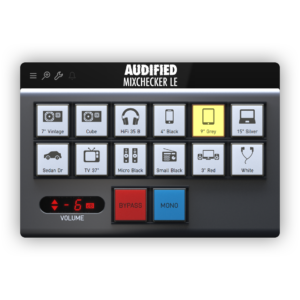
To get over 90 simulated listening devices and helpful mix analysis tools, discover MixChecker ULTRA
Now, how will this help you mix with your ears? You will put yourself precisely in the scenario mentioned at the start, resulting in you being able to foresee problems that might occur later, possibly even after releasing the track to the public. When you return to your mix setup, it will give you a to-do list of things to work on. Maybe the guitars were too loud, or the kick mic was not doing its job. Now, you don’t need to watch the meters so hard; you have a list of what needs fixing and know what felt good or bad during pure listening.
So here you have it. These tips will allow you to hear your mix differently, objectively, and in a greater context. They will make you less dependent on what your eyes see in plugin graphics. And by mixing with your ears more, your ears will be more pleased when listening to your final product.